Tuesday, December 10, 2019

How it all began - A concise history of Lebanon - Kamal Salibi -


How it all began -A concise history of Lebanon
-Kamal Salibi -

To create a country is one thing; to create a nationality is another. In the wake of the first world war, which ended with the destruction of the German, Austro-Hungarian, Russian and Ottoman empires, it was possible for the victorious Allies to redraw the political map of much of the world. In Europe, Germany and Austria-Hungary, defeated in the war, re-emerged as the German, Austrian and Hungarian republics. Meanwhile, the Bolshevik revolution was already beginning to transform the Russian empire into the Union of Soviet Socialist Republics. From European territories formerly German, Austro-Hungarian or Russian, new European states emerged. The overseas colonies of Germany, in Africa and elsewhere, were divided between Britain and France as mandates under licence from the newly organized League of Nations.

Meanwhile, the Ottoman empire, as a result of its defeat in the war, had virtually ceased to exist. The Turkish heartlands, successfully reclaimed from Allied occupation by the Kemalist revolution, were ultimately reconstituted as the Turkish Republic; but the Arab provinces in historical Mesopotamia and Syria were irretrievably lost, and subsequently divided between Britain and France, again as mandated territory, with the provision that they must be prepared as soon as possible for independence.

Here, as in Central and Eastern Europe, new states were formed, but with an important difference. In Europe, where nationalist thinking was already a firmly established tradition, the sense of separate nationality among the former subject peoples of the German, Austro-Hungarian and Russian empires was already in existence, and in most cases such clear and well-defined expectations were to be heeded in the formation of the new states. This was not the case with the Arab subjects of the Ottoman empire, where national consciousness, to the extent that it existed, was blurred and confounded by traditional loyalties of other kinds which were often in conflict with one another. The Allies felt they could ignore such rudimentary and confused national sentiments among the Arabs of their newly mandated territories as they set out to reorganize them into states, redrawing the political map of the Arab world in the manner which they thought suited them best.

By the spring of 1920 agreement had been reached between Britain and France at San Remo on how the former Arab territories of the defunct Ottoman empire would be divided between them. The principal considerations taken into account were oil and communications. During the course of the war, the British had gone to considerable trouble to occupy Mesopotamia. The onset of the war had brought home the supreme strategic importance of oil; the British already had command over the vast oil resources of Iran, and they were determined to prevent the Germans, who were major shareholders in the Turkish Petroleum Company, from gaining access to the proven Mesopotamian oil resources of Kirkuk. In 1916, an agreement negotiated between Mark Sykes on behalf of Britain, and Francois Georges-Picot on behalf of France (the so:called Sykes-Picot Agreement), had assigned the Vilayet (Ottoman province) of Mosul, in northern Mesopotamia, to the French, and the vilayets of Baghdad and Basra, in central and southern Mesopotamia, to the British. In Syria, France was to get the Vilayet of Aleppo and the northern parts of the Vilayets of Beirut and Damascus, leaving the southern parts of these two vilayets essentially to Britain, with the understanding that the Holy Land of Palestine would have an international status. During the last months of the war however the British, who already occupied much of Mesopotamia, took occupation of Palestine. Now, at San Remo, the wartime Sykes-Picot Agreement between the two sides was scrapped.

By the terms of the new agreement, France gave up her claim to the Vilayet of Mosul in return for a major share in the Turkish Petroleum Company, which had been confiscated by the Allies and reorganized as the Iraq Petroleum Company (IPC). Moreover, the older agreement had specified that France would have direct control over the coastal parts of the Vilayet of Aleppo and its share of the Vilayet of Beirut, but only a sphere of influence in inland Syria where an Arab state or states of independent status would be established. Under the new agreement, the French were to have a free hand in the whole area which they were to hold as a mandate under the League of Nations - a continuous stretch of territory extending from the Euphrates river to the Mediterranean coast. On the other hand, the British, in addition to keeping the whole of Mesopotamia as a mandate, were also to have the mandate over all the southern parts of the vilayets of Damascus and Beirut - a territory which they first called the Palestine east and west of the Jordan; then, more simply, Transjordan and Palestine. In effect, Britain came to control a stretch of north Arabian desert' territory which secured the required contiguity between its Mesopotamian and Palestinian mandates, and an uninterrupted overland route all the way from the borders of Iran to the Mediterranean.

Apart from its agreement with France over the partition of the Arab provinces of the Ottoman empire, Britain had made promises during the war to other parties concerning the same area. In central Arabia, there was a standing British alliance with Abdul-Aziz Ibn Saud, the Wahhabi Emir of Riyad who was subsequently to become the founder of the kingdom of Saudi Arabia. Wahhabism was a movement of militant Islamic religious revival which had appeared in central Arabia in the middle decades of the eighteenth century, and the house of Saud had been politically associated with it since that time. In conflict with this British-Saudi alliance was the wartime alliance reached between Britain and Sharif Husayn, the Emir of Mecca, who enjoyed a special Arab and Islamic prestige as a recognized descendant of the Prophet, and whose family were called the Hashemites.

In return for leading an Arab revolt against the Ottomans, the Sharif had been promised recognition as the head of an Arab kingdom the exact nature of which was left undefined. The Sharif, however, was led to understand that it would include all of Mesopotamia; all but a negotiable strip of coastal Syria; and the whole of peninsular Arabia, except for the parts which were already established as British protectorates. While the British relations with Ibn Saud were maintained by the British government of India, those with the Sharif were initiated and pursued by the British Arab Bureau in Cairo. Meanwhile, the British Foreign Office, in close touch with the World Zionist Organization, had by 1917 formally committed itself to viewing with favour the establishment of a Jewish National Home in Palestine.

Naturally, it was impossible for Britain after the war to honour simultaneously all these conflicting commitments fully. The need to reach a settlement with France over the area was most pressing, and this was taken care of by the San Remo agreement. During the last months of the war, as the British drove the Ottoman forces out of Syria, with the forces of Sharif Husayn's Arab Revolt protecting their right flank, the Sharif's third and most popular son, Faysal, was allowed to enter Damascus and establish an Arab government on behalf of his father in that ancient Arab capital. As the Allies met at San Remo to redraw the map of the Arab world, Sharif Faysal was proclaimed King of Syria, with a view to place Britain and France before an accomplished fact. Once the San Remo agreement had been concluded, however, the French, already in occupation of Beirut, made a show of trying to reach an accommodation with King Faysal; they then crushed his forces at Maysalun, outside Damascus, forcing him to abandon his short-lived Syrian kingdom. To compensate their gallant wartime ally for his loss, the British created another Arab kingdom for him out of the old Ottoman vilayets of Mesopotamia, which now became the kingdom of Iraq.

The British wartime commitment to facilitate the establishment of a Jewish National Home in the Palestine west of the Jordan, which again received high priority, was formalized in 1920 and included as a special article in the statutes of the British mandate for Palestine, as registered in the League of Nations. For the Palestine east of the Jordan, or Transjordan, a special administrative arrangement was soon made. In 1916, when Sharif Husayn solemnly declared the start of the Arab Revolt against the Turks in Mecca, he also proclaimed himself king of the Arabs, and the British actually recognized him as king of the Hijaz, which was the furthest they felt they could go at the time. After the war, however, Ibn Saud, with his Wahhabi forces, began to attack the Hijaz, and completed its conquest by putting an end to Sharifian rule there in 1925.

In the earlier stages of the Saudi-Sharifian conflict, the Sharifian forces, led by the Sharif's second son Abdallah, suffered a serious defeat in battle. Sharif Abdullah thereupon left the Hijaz in 1921 and arrived in Transjordan, where the British soon recognized him as the sovereign emir. With British military help, Abdullah succeeded in repelling Wahhabi attempts to extend the Saudi domain northwards in the direction of Syria, thereby securing the extension of Transjordan eastwards continuously to the border of Iraq. In the south, Abdullah's Transjordanian emirate extended beyond the borders of the old Ottoman Vilayet of Damascus to reach the Red Sea at the strategic Gulf of Aqaba, and so include the northernmost parts of what had formerly been the Ottoman Vilayet of the Hijaz. In the east, the border of the emirate, in the Jordan valley, set the limits beyond which the projected Jewish National Home in Palestine could not extend.

The British at the time knew what they wanted, and they got it: control over the oilfields of Iraq; unimpeded access from there to the Mediterranean; control of the Red Sea and the Persian Gulf (which were the two vital maritime highways leading to the Indian Ocean). To secure their interests, they naturally preferred to deal with parties in the area, or concerned with the area, who also knew what they wanted, and who were willing to make realistic accommodations to achieve their ends. During the war, the British had made a point of encouraging Arab nationalist activity in Syria against the Ottomans; and it was partly through British intermediaries that the Arab nationalists in Syria were put in touch with Sharif Husayn and his sons, which subsequently gave the Sharifian revolt in the Hijaz the extra dimension it needed to gain recognition as a true Arab Revolt. After the war, however, it became clear to the British that the claims of Arab nationalism were most urgently pressed either by romantic dreamers who were unwilling to be taughe that politics was the art of the possible, or by unprincipled schemers who were out to secure personal rather than national interests. In either case, the nationalist claims, it was felt, where they threatened to embarrass British interests, could be discounted at negligible cost.

However, there remained Britain's wartime Arab allies to deal with. In the Hijaz, King Husayn was demanding more than the British were prepared to give. He wanted to be recognized as king of all the Arabs; considered himself the rightful claimant of the caliphate of Islam; and was unwilling to recognize the arrangements which the Allies were determined to introduce to the area in accordance with the San Remo agreement. More than that, he was adamant in refusing to recognize the Jewish claims in Palestine, as approved by the British. His two sons, Abdullah and Faysal, took the more realistic view; so did his great rival in Arabia, Ibn Saud. Those were practical men who were willing to give and take, and settle for what was ultimately achievable in given circumstances. In the arrangements which the British made in the parts of the area allotted to them, or where they already wielded dominant influence, all three were readily accommodated.

In their own mandated territories, which they called the Levant, the French took the same attitude as the British: they were willing to attend to reasoned and concrete demands by parties who knew what they wanted, but had no patience for the claims and clamours of those who did not. In Mount Lebanon and the adjacent parts of the old Vilayet of Beirut, the Maronites - a Christian communion with a long tradition of union with the Roman Catholic church in Europe - were one party whose demands the French were prepared to listen to. Of all the Arabs, barring only individuals or politically experienced princely dynasties, they appeared to be the only people who knew precisely what they wanted: in their case, as they put it, a 'Greater Lebanon' under their paramount control, separate, distinct and independent from the rest of Syria. Behind them, the Maronites had a rich and eventful past which will be reviewed as a separate story in due course.

In 1861, with the help of France, they had already secured a special political status for their historical homeland of Mount Lebanon as a mutesarrifate, or privileged sanjak (administrative region), within the Ottoman system, under an international guaranty. Since the turn of the century, however, the Maronites had pressed for the extension of this small Lebanese territory to what they argued were its natural and historical boundaries: it would then include the coastal towns of Tripoli, Beirut, Sidon and Tyre and their respective hinterlands, which belonged to the Vilayet of Beirut; and the fertile valley of the Bekaa (the four Kazas, or administrtative districts, of Baalbek, the Bekaa, Rashayya and Hasbayya), which belonged to the Vilayet of Damascus. According to the Maronite argument, this 'Greater Lebanon' had always had a special social and historical character, different from that of its surroundings, which made it necessary and indeed imperative for France to help establish it as an independent state.

While France had strong sympathies for the Maronites, the French government did not support their demands without reserve. In Mount Lebanon, the Maronites had formed a clear majority of the population. In a 'Greater Lebanon', they were bound to be outnumbered by the Muslims of the coastal towns and their hinterlands, and by those of the Bekaa valley; and all the Christian communities together, in a 'Greater Lebanon', could at best amount to a bare majority. The Maronites, however, were insistent in their demands. Their secular and clerical leaders had pressed for them during the war years among the Allied powers, not excluding the United States. Af'ter the war, the same leaders, headed by the Maronite patriarch Elias Hoyek in person, pursued this course at the Paris Peace Conference; and in the end the French yielded. On 1 September 1920 - barely four months after the conclusion of the San Remo agreement; barely two months af'ter the flight of' King Faysal and his Arab government from Damascus - General Henri Gouraud, from the porch of his official residence as French High Commissioner in Beirut, proclaimed the birth of the State of Greater Lebanon, with Beirut as its capital. The flag of this new Lebanon was to be none other than the French tricolour itself, with a cedar tree - now hailed as the glorious symbol of the ancient country since Biblical times - featuring on the central white.

Following the establishment of the State of Greater Lebanon, the French turned to deal with the rest of their mandated territory in the Levant, where they were at a loss what to do. In the case of Lebanon, the Maronites had indicated precisely what they wanted. Elsewhere, no community seemed willing to speak its mind unequivocally, which lef't the French to their own devices. To begin with, in addition to Lebanon, they established four Syrian states: two of them regional, which were the State of Aleppo and the State of Damascus; and two of them ethno-religious, which were the State of the Alouites and the State of Jebel Druze. In response to strong nationalist demands, the states of Aleppo and Damascus were subsequently merged I l to form the State of Syria, later reconstituted as the Syrian Republic, to which Jebel Druze and the Alouite country were ultimately annexed. Meanwhile, on 23 May 1926, the State of Greater Lebanon received a Constitution which transformed it into the Lebanese Republic.

Thus the two sister republics came into being, Lebanon and Syria; both under French mandate, sharing the same currency and customs services, but flying different flags, and run by separate native administrations under one French High Commissioner residing in Beirut. Before long, each of the two sister countries had its own national anthem. But are administrative bureaucracies, flags and national anthems sufficient to make a true nation-state out of a given territory and the people who inhabit it? What about the question of nationality?

To the Maronites and many other Christians in Lebanon, there were no doubts about the matter. The Lebanese were Lebanese, and the Syrians were Syrians, just as the Iraqis were Iraqi, the Palestinians Palestinian, and the Transjordanians Transjordanian. If the Syrians, Iraqis, Palestinians or Transjordanians preferred to identify themselves as something else, such as Arabs united by one nationality, they were free to do so; but the Lebanese remained Lebanese, regardless of the extent to which the outside world might choose to classify them as Arabs, because their language happened to be Arabic. Theirs, it was claimed, was the heritage of ancient Phoenicia, which antedated the heritage they had come to share with the Arabs by thousands of years. Theirs, it was further claimed, was the broader Mediterranean heritage which they had once shared with Greece and Rome, and which they now shared with Western Europe. They also had a long tradition of proud mountain freedom and independence which was exclusively theirs, none of their neighbours ever having had the historical experience.

Unfortunately for the Maronites, however, not everybody in Lebanon thought or felt as they did. There were even many Maronites who dissented and freely expressed their divergent views. After all, who could reasonably deny that Lebanon, as a political entity, was a new country, just as the other Arab countries under French or British mandate were? Certainly, Lebanon was as much a new country as the others, but with an important difference: it had been willed into existence by a community of its own people, albeit one community among others. Moreover, those among its people who had willed it into existence were fully satisfied with what they got, and wanted the country to remain forever exactly as it had been finally constituted, without any territory added or subtracted.

The Syrian Republic, it is true, had also been finally put together in response to nationalist demand; in fact, following a nationalist uprising which lasted more than two years (1925-7), provoking a French bombardment of Damascus. In Syria, however, the nationalists were only partly satisfied with what they got, and continued to aspire for much more. They knew what they did not want rather than what they wanted, and what they were opposed to more than what they were in favour of. For a brief term, they had had an Arab kingdom, with its capital in historical Damascus, once the seat of the great Umayyad caliphs and the capital of the first Arab empire. The French had destroyed their kingdom and established statelets on its territory, among them Lebanon. The Maronites, they argued, were perhaps entitled to continue to enjoy the sort of autonomy they had enjoyed since the 1860s in the Ottoman Sanjak of Mount Lebanon, although they had no real reason to feel any different from other Syrians or Arabs. On the other hand, they had no right securing for their Greater Lebanon Syrian territory which had formerly belonged to the vilayets of Beirut or Damascus, and which had never formed part of their claimed historical homeland.

>From the Arab nationalist point of view, it was not permissible to accord the French-created Lebanese Republic recognition as a nation-state separate and distinct from Syria. Moreover, from the same point of view, the Syrian Republic itself was not acceptable as the final and immutable achievement of the aspirations of its people. The Syrians, after all, were Arabs, and their territory, historicallv. which had alwavs included Palestine and Transjordan along with Lebanon, was not a national territory on its own, but part of a greater Arab homeland: a homeland whose ancient heartlands were Syria, Iraq and Arabia, but which, since Islam, had also come to include Egypt and the countries of North Africa all the way to the Atlantic. During the war years, the Allies had cheated the Arabs. The British had promised them national independence on their historical homelands, but they had failed to honour their promises. Instead, they had partitioned this Arab territory with the French, and committed themselves to hand over a particularly precious part of it, namely Palestine, to the Jews.

To accept all this, or any part of it, would be nothing less than high treason. Equally unacceptable in principle, though admittedly problems of a less pressing nature, were the continuing British control of Egypt; the Italian colonization of Libya; and the French and Spanish imperial presence in the remaining parts of North Africa. This concept of one indivisible Arab national homeland extending all the way from the Indian Ocean to the Atlantic was expressed by the Damascene nationalist and man of letters, Fakhri al-Barudi, in a song which enjoyed wide circulation:

The countries of the Arabs are my homelands: >From Damascus to Baghdad; >From Syria to the Yemen, to Egypt, and all the way to Tetuan.

Significantly, the Syrian national anthem written by another Damascene nationalist, Khalil Mardam, did not sing the virtues of Syria as a nation-state standing by itself, but as the 'lion's den of Arabism', its glorious historical 'throne', and its sacred 'shrine'. By contrast the Lebanese national anthem, written by the Maronite poet Rashid Nakhleh, sang of the old men of Lebanon and the young, in the mountains and the plains, responding to the call of the historical fatherland and rallying around the 'eternal' cedar flag to defend 'Lebanon forever'.

Clearly, in the case of the Syrian Republic, the French had put together a state but failed to create a special nationality to go with it. The same, in a way, applied to Lebanon where, contrary to the claims of the national anthem, the concept of a natural and historical Lebanese nationality was meaningful to some people in the country, but not to others. The case was no different in the countries created by the British in their own mandated Arab territories.

In Palestine, which was assembled from what was formerly the Sanjak of Jerusalem and the southern parts of the Vilayet of Beirut, the British had deliberately attempted to recreate the Biblical Land of Israel, 'from Dan to Beersheba', where the Jews were to have their national homeland. The immigrant Jews actually called the country Eretz Israel, and looked forward to the day when it would be transformed into a Jewish state. To them, Palestine as a country was meaningful, but only as a prelude to something else: the Zionist concept of a Jewish nationality, reconstituted on what was conceived to be its historical home grounds. To its native Arab population, however, Palestine was no more of a natural country than Lebanon, Syria, Transjordan or Iraq, and might as well have been given another shape or size.

Transjordan, formed essentially out of the southern parts of the old Vilayet of Damascus, but with bits of Arabia added, was certainly not a natural country. Apart from a few towns and small clusters of villages scattered along the highlands east of the Jordan valley, and some pastoral areas and grainlands here and there, this Arab emirate consisted mostly of open desert. Even its founder, Emir Abdullah, did not regard it as a real country. To him it was no more than historical Arab territory salvaged for the cause of the Great Arab Revolt, to serve one day as a base for the re-establishment of a Greater Arab Syria. Significantly, Emir Abdullah called his army not the Transjordanian, but the Arab Legion. To the British and others, Abdullah's emirate may have appeared as a recreation of the Biblical territory of Edom and Moab, or of the Roman province of Arabia; but such concepts, certainlv at the time, were meaningless to the Transjordanians and did not readily contribute to a sense of separate historical nationality among them.

The British had hoped that Abdullah's younger brother Faysal, who was widely regarded in 1920 as the preeminent Arab national hero, would be a man of sufficient stature to make a real country out of Iraq, made up of the former Ottoman vilayets of Mosul, Baghdad, Basra and Shahrazor. Faysal's territory was declared politically independent almost immediately after its organization as a kingdom. Separated from other Arab countries by desert, and having the potential of enjoying a rich revenue from oil, Iraq could become a country on its own more easily than the others, as it had indeed been in ancient times, in the days of the Assyrians and the Babylonians. Internally, however, the Iraqis, apart from the Christian and Jewish minorities among them, were divided between Sunnites and Shiites, Arabs and Kurds. As King of Iraq, Faysal was surrounded by veterans of the Arab Revolt who had followed him to Baghdad in the flight from Damascus, and he himself never forgot his lost Syrian kingdom. His regime was more Arab nationalist than specifically Iraqi in character, dominated by the Sunnite Arab element and resented by the Shiite Arab element as well as by the Kurds. Much was indeed done under Faysal and his successors to assuage these resentments. Nevertheless, to the extent that it did develop, the sense of special nationality among the people of Iraq remained rudimentary and confused.

This was a new beginning in the history of the area: five countries formed out of Arab territory which had formerly been Ottoman, and none of them with a true or unarguable concept of special nationality to go with it. All things considered, all five of these countries were artificial creations established and given their initial organization by foreign imperial powers. Of the five, however, common Arab opinion singled out Lebanon as being an artificial creation of foreign imperialism in a special way. No one denied that the other four countries were equally artificial; the point lay elsewhere. Among the Syrians, Iraqis, Transjordanians and Palestinian Arabs, no one seriously advanced a thesis in support of the national validity of the given country. Among the Lebanese, however, there were those who did, which amounted to a serious aberration, and one which could not be allowed to pass. By refusing to accept the national validity of their given countries as a matter of Arab nationalist principle, the other Arabs, paradoxically, did manage in time to secure an accepted legitimacy for these countries as states. By the ready enthusiasm with which many Lebanese - but not all - accepted the validity of their country and the new nationality that went with it, what was immediately achieved was the exact reverse. The legitimacy of Lebanon alone as a state, for the Arabs in general and also among the Lebanese, remained in full question.

By willing not only a separate country but also a separate Lebanese nationality into existence, against the wishes of their neighbours and without the consent of people who were forced to become their compatriots, the Maronites and their overwhelmingly Christian supporters in Lebanon had broken the Arab consensus - more particularly, the Syrian Arab concensus - and they had to pay the price. This price was to be significantly heavier as the Maronites had actively solicited the help of France to achieve their ends; even more so, because they had knowingly exhibited a marked insensitivity to Arab frustrations around them. In October 1918, when French forces landed in Beirut to put an end to the short-lived Arab government of Sharif Faysal there, Maronites and other Christians waving French flags had cheered their arrival at the port, hailing France as the 'tender, loving mother' (Arabic, al-umm al-hanun) who was to be their saviour. Among the Muslims of Beirut, who had watched the arrival of the French with grave apprehension, this was not a matter to be easily forgotten. Between 1918 and 1920, while these same urbane Muslims of Beirut stood sullenly by, or kept to their homes, rough and fierce- looking Maronite mountaineers had descended from their villages to demonstrate in the streets of the city which they already took to be their own, clamouring for an 'independent' Greater Lebanon, and threatening to migrate to Europe in a body if they did not get it. Going beyond their demand of Lebanese 'independence', by which they meant independence from Syria, not from the French mandate, the Maronites at the time had not hesitated to express their continuing hostility to the Arab regime which was still established in Damascus. Before they could attain their Greater Lebanon, France had first to actualize its control over the rest of its Syrian territorial claim, and the Arab regime in Damascus had to be destroyed. At the battle of the Maysalun Pass, in the Anti-Lebanon, the French did crush the forces of King Faysal in July 1920, which finally opened the way for their occupation of Damascus. Maronite volunteers reportedly fought with the French in the battle, and there were open Maronite celebrations of the French victory, or rather of the Arab defeat. This was not to be forgotten in Damascus.

The creation of the new Arab state system had hardly been completed by the late 1920s and early 1930s when political inertia and vested interests began to give it a reality. As men of political ambition began to compete for power and position in the different countries, and as each of these countries came to have its own ruling establishment and administrative bureaucracy, the lines of demarcation between them, hardly any of which was a natural or historical frontier, began to harden. Everywhere, circumspect rulers and career politicians who actually worked for the consolidation of the system, as their interests dictated, made a point of denying its immutable validity, and never missed an opportunity to denounce it as an imperialist partition of the single Arab homeland. Palestine in one way, and Lebanon in another, stood out as exceptions. In Palestine, Arabs who aspired for leadership could only make their mark by yielding to popular nationalist pressure, because of the Jewish threat. This forced them to obstruct repeated attempts by the British mandatory authorities to provide the country with a political government, because in any such government the Jews, with the international influence they wielded, were bound to be greatly over- represented. Thus, the politically ambitious among the Palestinian Arabs had to compete for the leadership of the nationalist opposition, not for power and position in an actual ruling establishment. In Lebanon, while the Christian political establishment dominated by the Maronites was fully determined to make a success of the state, there was a Muslim opposition which was equally determined to make of it a failure. Here the Christian ruling establishment, secure with the backing of France, spoke its mind freely and acted accordingly, while the opposition, with the moral backing of the prevailing nationalist sentiment in Syria and other Arab countries, did the same.

It was not only the Christian political establishment, but also France who wanted to make of Lebanon a success; and France was fully alert to the country's fundamental problem: unless the Christians managed to sell the idea of Lebanon to their Muslim compatriots, Lebanon as a state could not gain the required minimum of legitimacy it needed, politically, to be truly viable. France, as the historical friend of the Maronites, was willing to do for them and their fellow Christians all it could do. It had already established for them the Greater Lebanon they wanted, to some extent against its better judgement. It now helped them to organize their state, and for the time being provided it with the needed power protection. More than that France could only give advice, because one day they would be on their own: the advice was given, and even pressed. Maronite leaders who accepted it, and began to show prudence in speech and action, were given all the necessary backing to reach office. Those who did not accept the advice received no support; and when they happened to be in office, they were left in political isolation, and their wiser opponents were helped to bring them down.


Originally, the Maronites had wanted Lebanon, politically, for themselves. When the country received its Constitution and became a parliamentary republic, the French saw to it that a Greek Orthodox Christian rather than a Maronite became its first president, with a Sunnite Muslim as a speaker of its parliament; but the Maronites nevertheless managed to secure for themselves all other key positions in the government and the administration, and ultimately the presidency of the republic as well. What made this possible, at the initial stages, was the effective boycott of the state by all but a handful of the Sunnite Muslims, who were the only community in the country who could have stopped the Maronites from achieving their virtual monopoly of power at the time. Stage by stage, however, the French saw to it that the effectiveness of this Muslim boycott of the state was eroded, and pressed on the Maronite leaderships the vital necessity of giving the Muslims enough stake in the country to encourage them to help maintain the state. To many Maronites, this appeared as an outright French betrayal of their cause. Others were willing to learn, though not always as much as needed.

In Lebanon, however, the Christians on the whole had an advantage over the Muslims. By and large, in rank and file, they were socially far more developed or, more correctly, far more familiar with the ways of the modern world. This placed them in a position to provide the country, for a long time, with most of the needed infrastructure. It also enabled them to provide a social gloss which covered the fragile and faulty structure of the state and the social tension which lay underneath, mainly due to the glaringly uneven development of the different Lebanese communities and regions. Outside Lebanon, except for Egypt, this kind of gloss at the time, on the required scale, was not to be found elsewhere in the Arab world. It certainly existed in Palestine, even more so than in Lebanon; but there it was provided largely by the European Jewish settlers rather than by the Palestinian Arabs, among whom development was limited to a small middle and upper class.

What further helped to cover up the faults of Lebanon was the stunning natural beauty of the country, coupled with its pleasant Mediterranean climate. Lebanon, moreover, was relatively green, and could appear lush green - a veritable paradise - by contrast with the desert which began as one crossed the eastern borders from the Bekaa valley into Syria. Where else, in the Arab world, could one see majestic peaks capped with snow for much of the year, rising hoary above terraced mountain slopes dotted with the red roof-tops of countless villages nestled among orchards or vineyards, set against a stark blue sky, and directly overlooking the sparkling waters of the Mediterranean? Yet another initial advantage of the country was its geographic location, which could make of it the ideal gateway from the West to the Arab world. In addition to all this, there was the experienced mercantile initiative and exceptional adaptability of the people, and the cultural tolerance which they generally exhibited, most notably in the coastal cities, and most of all in cosmopolitan Beirut.

All that Lebanon needed to be a success was political accord and an even social development among the different communities which had come to form its population and in the different regions it had come to comprise. However, for two reasons, it was exactly these conditions that proved hard to reach. First, the Maronites in Lebanon were determined to maintain their own paramount control of the state, and were fundamentally unwilling to have Christians and Muslims share in the country as political equals; their argument was that the Muslims were naturally susceptible to the strong influence of their co-religionists in other Arab countries, and could therefore not be trusted with the more sensitive political and administrative positions in Lebanon, such as those which involved national security and ultimate decision making. Second, the prevalent nationalist mood in the Arab world, especially in Syria, was against Lebanon achieving political success; and within the country, the Muslim sector of the population could easily be swayed by external Arab nationalist influence, and could be used by other Arab countries as political leverage to keep the Lebanese state perennially unstable. For the duration of the French mandate in the Levant, Lebanon was adequately protected against such destabilizing Arab interventions in its affairs. The real problems of the country, however, were to come blatantly into the open as soon as the French mandate came to an end, leaving an independent Lebanon at the mercy of external and internal forces acting in the name of Arab nationalism with which the Lebanese state, in the long run, was unable to come to reasonable terms.

Thus in Lebanon, from the very beginning, a force called Arabism, acting from outside and inside the country, stood face to face with another exclusively parochial social force called Lebanism; and the two forces collided on every fundamental issue, impeding the normal development of the state and keeping its political legitimacy and ultimate viability continuously in question. Each force, at the internal level, claimed to represent a principle and ideal involving a special concept of nationality; yet in each case one had to look behind the articulated argument to discover the real nature of the quarrel. True, there were individuals in Lebanon who sincerely believed in the historical and political validity of Lebanism, and others who were committed to Arabism with equal sincerity. But it was certainly no accident that the original proponents of Lebanism in the country were almost exclusively Christians, and for the most part Maronites, while the most unbending proponents of Arabism, as a community, were the Muslims. Clearly, in both cases, what was actually said by way of argument on the surface covered something else underneath: the source of the problems. What was this underlying element in each case, which made the declared positions of the two sides so irreconcilable as to keep the question of Lebanon. interminably, an outstanding one? 


Kamal Salibi is the foremost historian of Lebanon, and his new book is even more important than his earlier one because it throws light on the present and future of the country as well as its past. With unique knowledge and insight, he shows how the ideas of the various communities and groups about what Lebanon is and should be are rooted in very different visions of history.
Albert Hourani, St Antony's College, Oxford

Monday, December 9, 2019

Kahlil Gibran on Silence, Solitude, and the Courage to Know Yourself


Kahlil Gibran on Silence, Solitude, and the Courage to Know Yourself

“In much of your talking, thinking is half murdered. For thought is a bird of space, that in a cage of words may indeed unfold its wings but cannot fly.”

By Maria Popova


Kahlil Gibran on Silence, Solitude, and the Courage to Know Yourself
Something strange and wondrous begins to happen when one spends stretches of time in solitude, in the company of trees, far from the bustle of the human world with its echo chamber of judgments and opinions — a kind of rerooting in one’s deepest self-knowledge, a relearning of how to simply be oneself, one’s most authentic self. Wendell Berry knew this when he observed that “true solitude is found in the wild places, where one is without human obligation” — the places where “one’s inner voices become audible.”

But that inner voice, I have found, exists in counterpoise to the outer voice — the more we are tasked with speaking, with orienting lip and ear to the world without, the more difficult it becomes to hear the hum of the world within and feel its magmatic churns of self-knowledge. “Who knows doesn’t talk. Who talks doesn’t know,” Ursula K. Le Guin wrote in in her superb poetic, philosophical, feminist more-than-translation of the Tao te Ching.
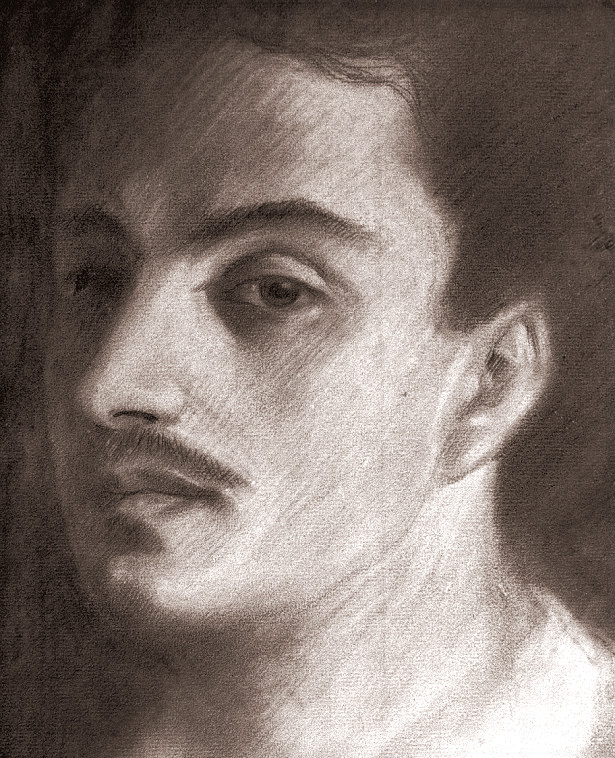
Kahlil Gibran, self-portrait
Two and a half millennia after Lao Tzu, and a century before Le Guin and Berry, Kahlil Gibran (January 6, 1883–April 10, 1931) — another philosopher-poet of the highest order and most timeless hold — addressed the relationship between silence, solitude, and self-knowledge in a portion of his 1923 classic The Prophet (public library).

When Gibran’s prophet-protagonist is asked to address the matter of talking, he responds:

You talk when you cease to be at peace with your thoughts;
And when you can no longer dwell in the solitude of your heart you live in your lips, and sound is a diversion and a pastime.
And in much of your talking, thinking is half murdered.
For thought is a bird of space, that in a cage of words may indeed unfold its wings but cannot fly.
One of Andrea Dezsö’s haunting illustrations for the original, uncensored edition of the Brothers Grimm fairy tales
Echoing Hermann Hesse’s insistence on the courage necessary for solitude, Gibran’s prophet adds:

There are those among you who seek the talkative through fear of being alone.
The silence of aloneness reveals to their eyes their naked selves and they would escape.
And there are those who talk, and without knowledge or forethought reveal a truth which they themselves do not understand.
And there are those who have the truth within them, but they tell it not in words.
In the bosom of such as these the spirit dwells in rhythmic silence.


What Is a Philosopher?- Simon Critchley-


MAY 16, 2010, 5:00 PM

What Is a Philosopher?
By Simon Critchley

"The philosopher’s clumsiness in worldly affairs makes him appear stupid or, “gives the impression of plain silliness.” We are left with a rather Monty Pythonesque definition of the philosopher: the one who is silly."

There are as many definitions of philosophy as there are philosophers – perhaps there are even more. After three millennia of philosophical activity and disagreement, it is unlikely that we’ll reach consensus, and I certainly don’t want to add more hot air to the volcanic cloud of unknowing. What I’d like to do in the opening column in this new venture — The Stone — is to kick things off by asking a slightly different question: what is a philosopher?

As Alfred North Whitehead said, philosophy is a series of footnotes to Plato. Let me risk adding a footnote by looking at Plato’s provocative definition of the philosopher that appears in the middle of his dialogue, “Theaetetus,” in a passage that some scholars consider a “digression.” But far from being a footnote to a digression, I think this moment in Plato tells us something hugely important about what a philosopher is and what philosophy does.

Socrates tells the story of Thales, who was by some accounts the first philosopher. He was looking so intently at the stars that he fell into a well. Some witty Thracian servant girl is said to have made a joke at Thales’ expense — that in his eagerness to know what went on in the sky he was unaware of the things in front of him and at his feet. Socrates adds, in Seth Benardete’s translation, “The same jest suffices for all those who engage in philosophy.”

What is a philosopher, then? The answer is clear: a laughing stock, an absent-minded buffoon, the butt of countless jokes from Aristophanes’ “The Clouds” to Mel Brooks’s “History of the World, part one.” Whenever the philosopher is compelled to talk about the things at his feet, he gives not only the Thracian girl but the rest of the crowd a belly laugh. The philosopher’s clumsiness in worldly affairs makes him appear stupid or, “gives the impression of plain silliness.” We are left with a rather Monty Pythonesque definition of the philosopher: the one who is silly.

But as always with Plato, things are not necessarily as they first appear, and Socrates is the greatest of ironists. First, we should recall that Thales believed that water was the universal substance out of which all things were composed. Water was Thales’ philosophers’ stone, as it were. Therefore, by falling into a well, he inadvertently presses his basic philosophical claim.

But there is a deeper and more troubling layer of irony here that I would like to peel off more slowly. Socrates introduces the “digression” by making a distinction between the philosopher and the lawyer, or what Benardete nicely renders as the “pettifogger.” The lawyer is compelled to present a case in court and time is of the essence. In Greek legal proceedings, a strictly limited amount of time was allotted for the presentation of cases. Time was measured with a water clock or clepsydra, which literally steals time, as in the Greek kleptes, a thief or embezzler. The pettifogger, the jury, and by implication the whole society, live with the constant pressure of time. The water of time’s flow is constantly threatening to drown them.

By contrast, we might say, the philosopher is the person who has time or who takes time. Theodorus, Socrates’ interlocutor, introduces the “digression” with the words, “Aren’t we at leisure, Socrates?” The latter’s response is interesting. He says, “It appears we are.” As we know, in philosophy appearances can be deceptive. But the basic contrast here is that between the lawyer, who has no time, or for whom time is money, and the philosopher, who takes time. The freedom of the philosopher consists in either moving freely from topic to topic or simply spending years returning to the same topic out of perplexity, fascination and curiosity.

Pushing this a little further, we might say that to philosophize is to take your time, even when you have no time, when time is constantly pressing at your back. The busy readers of The New York Times will doubtless understand this sentiment. It is our hope that some of them will make the time to read The Stone. As Wittgenstein says, “This is how philosophers should salute each other: ‘Take your time.’ ” Indeed, it might tell you something about the nature of philosophical dialogue to confess that my attention was recently drawn to this passage from Theaetetus in leisurely discussions with a doctoral student at the New School, Charles Snyder.

Socrates says that those in the constant press of business, like lawyers, policy-makers, mortgage brokers and hedge fund managers, become ”bent and stunted” and they are compelled “to do crooked things.” The pettifogger is undoubtedly successful, wealthy and extraordinarily honey-tongued, but, Socrates adds, “small in his soul and shrewd and a shyster.” The philosopher, by contrast, is free by virtue of his or her otherworldliness, by their capacity to fall into wells and appear silly.

Socrates adds that the philosopher neither sees nor hears the so-called unwritten laws of the city, that is, the mores and conventions that govern public life. The philosopher shows no respect for rank and inherited privilege and is unaware of anyone’s high or low birth. It also does not occur to the philosopher to join a political club or a private party. As Socrates concludes, the philosopher’s body alone dwells within the city’s walls. In thought, they are elsewhere.

This all sounds dreamy, but it isn’t. Philosophy should come with the kind of health warning one finds on packs of European cigarettes: PHILOSOPHY KILLS. Here we approach the deep irony of Plato’s words. Plato’s dialogues were written after Socrates’ death. Socrates was charged with impiety towards the gods of the city and with corrupting the youth of Athens. He was obliged to speak in court in defense of these charges, to speak against the water-clock, that thief of time. He ran out of time and suffered the consequences: he was condemned to death and forced to take his own life.

A couple of generations later, during the uprisings against Macedonian rule that followed the death of Alexander the Great in 323 B.C.E., Alexander’s former tutor, Aristotle, escaped Athens saying, “I will not allow the Athenians to sin twice against philosophy.” From the ancient Greeks to Giordano Bruno, Spinoza, Hume and right up to the shameful lawsuit that prevented Bertrand Russell from teaching at the City College of New York in 1940 on the charge of sexual immorality and atheism, philosophy has repeatedly and persistently been identified with blasphemy against the gods, whichever gods they might be. Nothing is more common in the history of philosophy than the accusation of impiety. Because of their laughable otherworldliness and lack of respect for social convention, rank and privilege, philosophers refuse to honor the old gods and this makes them politically suspicious, even dangerous. Might such dismal things still happen in our happily enlightened age? That depends where one casts one’s eyes and how closely one looks.

Perhaps the last laugh is with the philosopher. Although the philosopher will always look ridiculous in the eyes of pettifoggers and those obsessed with maintaining the status quo, the opposite happens when the non-philosopher is obliged to give an account of justice in itself or happiness and misery in general. Far from eloquent, Socrates insists, the pettifogger is “perplexed and stutters.”

Of course, one might object, that ridiculing someone’s stammer isn’t a very nice thing to do. Benardete rightly points out that Socrates assigns every kind of virtue to the philosopher apart from moderation. Nurtured in freedom and taking their time, there is something dreadfully uncanny about the philosopher, something either monstrous or god-like or indeed both at once. This is why many sensible people continue to think the Athenians had a point in condemning Socrates to death. I leave it for you to decide. I couldn’t possibly judge.


Simon Critchley is chair of philosophy at the New School for Social Research in New York, and part-time professor at Tilburg University in the Netherlands. He is the author of several books, including “The Book of Dead Philosophers,” and is moderator of this series.

Sunday, December 8, 2019

The Funeral Oration , Pericles


The Funeral Oration, 
-Pericles-

At the end of the first year of war, the Athenians held, as was their custom, an elaborate funeral for all those killed in the war. The funeral oration over these dead was delivered by the brilliant and charismatic politician and general, Pericles, who perished a little bit later in the horrifying plague that decimated Athens the next year. The Funeral Oration is the classic statement of Athenian ideology, containing practically in full the patriotic sentiment felt by most Athenians. What I want you to ask yourself is: according to Pericles, what precisely makes Athens great? How does this compare to other city-states? What problems do you see in Pericles' description of Athens?

Most of those who have spoken here before me have commended the lawgiver who added this oration to our other funeral customs. It seemed to them a worthy thing that such an honor should be given at their burial to the dead who have fallen on the field of battle. But I should have preferred that, when men's deeds have been brave, they should be honored in deed only, and with such an honor as this public funeral, which you are now witnessing. Then the reputation of many would not have been imperiled on the eloquence or want of eloquence of one, and their virtues believed or not as he spoke well or ill. For it is difficult to say neither too little nor too much; and even moderation is apt not to give the impression of truthfulness. The friend of the dead who knows the facts is likely to think that the words of the speaker fall short of his knowledge and of his wishes; another who is not so well informed, when he hears of anything which surpasses his own powers, will be envious and will suspect exaggeration. Mankind are tolerant of the praises of others so long as each hearer thinks that he can do as well or nearly as well himself, but, when the speaker rises above him, jealousy is aroused and he begins to be incredulous. However, since our ancestors have set the seal of their approval upon the practice, I must obey, and to the utmost of my power shall endeavor to satisfy the wishes and beliefs of all who hear me.

I will speak first of our ancestors, for it is right and seemly that now, when we are lamenting the dead, a tribute should be paid to their memory. There has never been a time when they did not inhabit this land, which by their valor they will have handed down from generation to generation, and we have received from them a free state. But if they were worthy of praise, still more were our fathers, who added to their inheritance, and after many a struggle transmitted to us their sons this great empire. And we ourselves assembled here today, who are still most of us in the vigor of life, have carried the work of improvement further, and have richly endowed our city with all things, so that she is sufficient for herself both in peace and war. Of the military exploits by which our various possessions were acquired, or of the energy with which we or our fathers drove back the tide of war, Hellenic or Barbarian, I will not speak; for the tale would be long and is familiar to you. But before I praise the dead, I should like to point out by what principles of action we rose ~ to power, and under what institutions and through what manner of life our empire became great. For I conceive that such thoughts are not unsuited to the occasion, and that this numerous assembly of citizens and strangers may profitably listen to them.

Our form of government does not enter into rivalry with the institutions of others. Our government does not copy our neighbors', but is an example to them. It is true that we are called a democracy, for the administration is in the hands of the many and not of the few. But while there exists equal justice to all and alike in their private disputes, the claim of excellence is also recognized; and when a citizen is in any way distinguished, he is preferred to the public service, not as a matter of privilege, but as the reward of merit. Neither is poverty an obstacle, but a man may benefit his country whatever the obscurity of his condition. There is no exclusiveness in our public life, and in our private business we are not suspicious of one another, nor angry with our neighbor if he does what he likes; we do not put on sour looks at him which, though harmless, are not pleasant. While we are thus unconstrained in our private business, a spirit of reverence pervades our public acts; we are prevented from doing wrong by respect for the authorities and for the laws, having a particular regard to those which are ordained for the protection of the injured as well as those unwritten laws which bring upon the transgressor of them the reprobation of the general sentiment.

And we have not forgotten to provide for our weary spirits many relaxations from toil; we have regular games and sacrifices throughout the year; our homes are beautiful and elegant; and the delight which we daily feel in all these things helps to banish sorrow. Because of the greatness of our city the fruits of the whole earth flow in upon us; so that we enjoy the goods of other countries as freely as our own.

Then, again, our military training is in many respects superior to that of our adversaries. Our city is thrown open to the world, though and we never expel a foreigner and prevent him from seeing or learning anything of which the secret if revealed to an enemy might profit him. We rely not upon management or trickery, but upon our own hearts and hands. And in the matter of education, whereas they from early youth are always undergoing laborious exercises which are to make them brave, we live at ease, and yet are equally ready to face the perils which they face. And here is the proof: The Lacedaemonians come into Athenian territory not by themselves, but with their whole confederacy following; we go alone into a neighbor's country; and although our opponents are fighting for their homes and we on a foreign soil, we have seldom any difficulty in overcoming them. Our enemies have never yet felt our united strength, the care of a navy divides our attention, and on land we are obliged to send our own citizens everywhere. But they, if they meet and defeat a part of our army, are as proud as if they had routed us all, and when defeated they pretend to have been vanquished by us all.

If then we prefer to meet danger with a light heart but without laborious training, and with a courage which is gained by habit and not enforced by law, are we not greatly the better for it? Since we do not anticipate the pain, although, when the hour comes, we can be as brave as those who never allow themselves to rest; thus our city is equally admirable in peace and in war. For we are lovers of the beautiful in our tastes and our strength lies, in our opinion, not in deliberation and discussion, but that knowledge which is gained by discussion preparatory to action. For we have a peculiar power of thinking before we act, and of acting, too, whereas other men are courageous from ignorance but hesitate upon reflection. And they are surely to be esteemed the bravest spirits who, having the clearest sense both of the pains and pleasures of life, do not on that account shrink from danger. In doing good, again, we are unlike others; we make our friends by conferring, not by receiving favors. Now he who confers a favor is the firmer friend, because he would rather by kindness keep alive the memory of an obligation; but the recipient is colder in his feelings, because he knows that in requiting another's generosity he will not be winning gratitude but only paying a debt. We alone do good to our neighbors not upon a calculation of interest, but in the confidence of freedom and in a frank and fearless spirit. To sum up: I say that Athens is the school of Hellas, and that the individual Athenian in his own person seems to have the power of adapting himself to the most varied forms of action with the utmost versatility and grace. This is no passing and idle word, but truth and fact; and the assertion is verified by the position to which these qualities have raised the state. For in the hour of trial Athens alone among her contemporaries is superior to the report of her. No enemy who comes against her is indignant at the reverses which he sustains at the hands of such a city; no subject complains that his masters are unworthy of him. And we shall assuredly not be without witnesses; there are mighty monuments of our power which will make us the wonder of this and of succeeding ages; we shall not need the praises of Homer or of any other panegyrist whose poetry may please for the moment, although his representation of the facts will not bear the light of day. For we have compelled every land and every sea to open a path for our valor, and have everywhere planted eternal memorials of our friendship and of our enmity. Such is the city for whose sake these men nobly fought and died; they could not bear the thought that she might be taken from them; and every one of us who survive should gladly toil on her behalf.

I have dwelt upon the greatness of Athens because I want to show you that we are contending for a higher prize than those who enjoy none of these privileges, and to establish by manifest proof the merit of these men whom I am now commemorating. Their loftiest praise has been already spoken. For in magnifying the city I have magnified them, and men like them whose virtues made her glorious. And of how few Hellenes 1 can it be said as of them, that their deeds when weighed in the balance have been found equal to their fame! I believe that a death such as theirs has been the true measure of a man's worth; it may be the first revelation of his virtues, but is at any rate their final seal. For even those who come short in other ways may justly plead the valor with which they have fought for their country; they have blotted out the evil with the good, and have benefited the state more by their public services than they have injured her by their private actions. None of these men were enervated by wealth or hesitated to resign the pleasures of life; none of them put off the evil day in the hope, natural to poverty, that a man, though poor, may one day become rich. But, deeming that the punishment of their enemies was sweeter than any of these things, and that they could fall in no nobler cause, they determined at the hazard of their lives to be honorably avenged, and to leave the rest. They resigned to hope their unknown chance of happiness; but in the face of death they resolved to rely upon themselves alone. And when the moment came they were minded to resist and suffer, rather than to fly and save their lives; they ran away from the word of dishonor, but on the battlefield their feet stood fast, and in an instant, at the height of their fortune, they passed away from the scene, not of their fear, but of their glory.

Such was the end of these men; they were worthy of Athens, and the living need not desire to have a more heroic spirit, although they may pray for a less fatal issue. The value of such a spirit is not to be expressed in words. Any one can discourse to you for ever about the advantages of a brave defense, which you know already. But instead of listening to him I would have you day by day fix your eyes upon the greatness of Athens, until you become filled with the love of her; and when you are impressed by the spectacle of her glory, reflect that this empire has been acquired by men who knew their duty and had the courage to do it, who in the hour of conflict had the fear of dishonor always present to them, and who, if ever they failed in an enterprise, would not allow their virtues to be lost to their country, but freely gave their lives to her as the fairest offering which they could present at her feast. The sacrifice which they collectively made was individually repaid to them; for they received again each one for himself a praise which grows not old, and the noblest of all tombs, I speak not of that in which their remains are laid, but of that in which their glory survives, and is proclaimed always and on every fitting occasion both in word and deed. For the whole earth is the tomb of famous men; not only are they commemorated by columns and inscriptions in their own country, but in foreign lands there dwells also an unwritten memorial of them, graven not on stone but in the hearts of men. Make them your examples, and, esteeming courage to be freedom and freedom to be happiness, do not weigh too nicely the perils of war. The unfortunate who has no hope of a change for the better has less reason to throw away his life than the prosperous who, if he survive, is always liable to a change for the worse, and to whom any accidental fall makes the most serious difference. To a man of spirit, cowardice and disaster coming together are far more bitter than death striking him unperceived at a time when he is full of courage and animated by the general hope.

Wherefore I do not now pity the parents of the dead who stand here; I would rather comfort them. You know that your dead have passed away amid manifold vicissitudes; and that they may be deemed fortunate who have gained their utmost honor, whether an honorable death like theirs, or an honorable sorrow like yours, and whose share of happiness has been so ordered that the term of their happiness is likewise the term of their life. I know how hard it is to make you feel this, when the good fortune of others will too often remind you of the gladness which once lightened your hearts. And sorrow is felt at the want of those blessings, not which a man never knew, but which were a part of his life before they were taken from him. Some of you are of an age at which they may hope to have other children, and they ought to bear their sorrow better; not only will the children who may hereafter be born make them forget their own lost ones, but the city will be doubly a gainer. She will not be left desolate, and she will be safer. For a man's counsel cannot have equal weight or worth, when he alone has no children to risk in the general danger. To those of you who have passed their prime, I say: "Congratulate yourselves that you have been happy during the greater part of your days; remember that your life of sorrow will not last long, and be comforted by the glory of those who are gone. For the love of honor alone is ever young, and not riches, as some say, but honor is the delight of men when they are old and useless.

To you who are the sons and brothers of the departed, I see that the struggle to emulate them will be an arduous one. For all men praise the dead, and, however preeminent your virtue may be, I do not say even to approach them, and avoid living their rivals and detractors, but when a man is out of the way, the honor and goodwill which he receives is unalloyed. And, if I am to speak of womanly virtues to those of you who will henceforth be widows, let me sum them up in one short admonition: To a woman not to show more weakness than is natural to her sex is a great glory, and not to be talked about for good or for evil among men.

I have paid the required tribute, in obedience to the law, making use of such fitting words as I had. The tribute of deeds has been paid in part; for the dead have them in deeds, and it remains only that their children should be maintained at the public charge until they are grown up: this is the solid prize with which, as with a garland, Athens crowns her sons living and dead, after a struggle like theirs. For where the rewards of virtue are greatest, there the noblest citizens are enlisted in the service of the state. And now, when you have duly lamented, every one his own dead, you may depart.


The Meditations of the Emperor Marcus Aurelius Antoninus . -Book VI-

The Meditations of the Emperor Marcus Aurelius Antoninus .
-Book VI-
*
1. The substance of the Universe is docile and pliable. The mind which governs it has in itself no source of evil-doing. It has no malice: it does no ill, and nothing is hurt by it. By its guidance all things come to be, and fulfil their being.

2. Act the part which is worthy of you, regarding not whether you be stiff with cold or comfortably warm; whether you be drowsy or refreshed with sleep; whether you be in good report or bad; whether you be dying or upon some other business. For death also is one piece of the business of life, and, here as elsewhere, it is enough to do well what comes to our hand.

3. Look within. Let not the proper quality or value of anything escape you.

4. All that exists will very speedily change; by rarefaction, if all substance be one; otherwise by dispersion.

5. The guiding mind knows what its own condition is, how, and upon what matter its work is done.

6. The best revenge is not to copy him that wronged you.

7. Find your sole delight and recreation in proceeding from one unselfish action to another, with God ever in mind.

8. The ruling part of you is that which rouses and steers itself, making itself what it wishes to be, and making all that happens take such appearance as it will.

9. All things are accomplished according to the will of universal nature. There is no other nature to influence them which either comprehends the former from without, or is contained within it, or exists externally, and independent of it.

10. The Universe is either a confusion ravelled and unravelled again, or else a unity compact of order and forethought. If it be the former, why should I wish to linger amid this aimless chaos and confusion, or have any further care than how to become earth again? Nay, why am I disturbed at all? Dissolution will overtake me, do what I please. But, if the latter be the case, I adore the Ruler of all things, I stand firm, and put my trust in him.

11. Whenever your situation forces trouble upon you, return quickly to yourself, and interrupt the rhythm of life no longer than you are compelled. Your grasp of the harmony will grow surer by continual recurrence to it.

12. Had you at one time both a step-mother and a mother, you would respect the former, yet you would be more constantly in your mother's company. Your court and your philosophy are step-mother and mother to you. Return then frequently to your true mother, and recreate yourself with her. Her consolation can make the court seem bearable to you, and you to it.

13. Keep these thoughts for meats and eatables: This that is before me is the dead carcase of a fish, a fowl, a hog. This Falernian is but a little grape juice. Think of your purple robes as sheep's wool stained in the blood of a shell-fish. Such conceptions, which touch reality so near, and set forth the sum and substance of these objects, are powerful indeed to display to us their despicable value. In this spirit we should act throughout life; and when things of great apparent worth present themselves, we should strip them naked, view their meanness, and cast aside the glowing description which makes them seem so glorious. Vanity is a great sophist, and most imposes on us when we believe ourselves to be busy about the noblest ends. Remember the saying of Crates about Xenocrates himself.

14. Most objects of vulgar admiration may be referred to certain general classes. There are, first, those which hold together by cohesion or by some organic unity, such as stone, timber, figs, vines or olives. The things which men, a shade more reasonable, admire are referred to the class which possesses animal life such as is seen in flocks and herds. When man's taste is still more cultured his admiration turns to things which can show a rational intelligence. But he admires this intelligence not as a universal principle, but only so far as he finds it expressed in art or industry, or, indeed, sometimes merely so far as it is exhibited by his retinue of artist slaves. But he who values rational intelligence as a universal thing, and as a social force, will care nothing for these other objects of admiration. He will, above all things, strive to preserve his own mind in all its rational and social instincts and activities; and to this end he will co-operate with any of his kind.

15. Some things hasten into being. Some hasten to be no more. Even as a thing is born some part of it is already dead. Flux and change are constantly renewing the world, just as the unbroken flow of time ever presents to us some new portion of eternity. In this vast river, on whose bosom there is no tarrying, what is there among the things that sweep by us that is worth the prizing? It is as if a man grew fond of one among a passing flight of sparrows, when already it had vanished from his sight. Our life itself is much like a vapour of the blood or a drawing in of air. Our momentary actions of inhalation and exhalation are one in kind with that whole power of breathing which, yesterday or the day before, we received at birth, and which we must restore again to the source from whence we drew it.

16. It is a small privilege to transpire like plants, or even to breathe as cattle or wild beasts do. To feel the impressions of sense, to be swayed like puppets by passion, to herd together and to live by bread; all this is no great thing. There is nothing here superior to our power of discharging our superfluous food. What, then, is of value? To be received with clapping of hands? No. Neither, therefore, is the applause of tongues more valuable, for the praises of the multitude are naught but the idle clapping of tongues. Dismiss the vanity called fame, and what remains to be prized? This, I think: in all things to act, or to restrain yourself from action, as best suits the particular structure of your nature. This is the end of all arts and studies, for every art aims at making what it produces well adapted to the work for which it was designed. The gardener, the vine-dresser, the horse-breaker, the dog-trainer all try for this; and what else is the aim of all education and teaching? Here, then, is what you may truly value: this well won, you will seek for nothing more. Will you, then, cease valuing the multitude of other things? If you do not, you will never attain to freedom, self-sufficiency, or tranquillity. You cannot escape envying, suspecting, and striving against those who have the power to deprive you of your cherished objects, nor plotting against men who are in possession of that on which you set your heart. The man who lacks any of these things must, of necessity, be distracted, and be for ever complaining against the Gods. But reverence and respect for your own intelligence will bring you to agreement with yourself, into concord with mankind, and into harmony with the Gods, whom you will praise for all their good gifts and guidance.

17. Upward, downward, round and round run the courses of the elements. But the course of virtue is like none of these; it follows a diviner path, well-directed in a way that is hard for us to understand.

18. Strange are the ways of men! They can speak no good word of the contemporaries with whom they live; yet they count it a great thing to gain the praises of a posterity whom they never saw nor shall see. As well might we grieve because we cannot hear the praises of our ancestors.

19. If a thing seems to you very difficult to accomplish, conclude not that it is beyond human power. But, if you see that anything is within man's power, and part of his proper work, conclude that you also may attain to it.

20. In the gymnasium, if some one scratches us with his nails, or in a sudden onset bruises our head, we express no resentment; we are not offended; nor do we suspect him for the future as one who is plotting against us. We are on our guard against him, it is true, but not as against an enemy or a suspected person. In all good humour we simply keep out of his way. Let us thus behave in other affairs of life, and overlook the many injuries which are done to us, as it were, by our antagonists in the gymnasium of the world. As I said, we may keep out of their way, but without suspicion or hatred.

21. If any one can convince or shew me that I am wrong in thought or deed, I will gladly change. It is truth that I seek; and truth never yet hurt any man. What does hurt is persistence in error or in ignorance.

22. I do my duty, and for the rest am not distracted by anything which is inanimate or irrational, or which has lost or ignores the proper way.

23. Use the brute creation, and also all material things, in the spirit of magnanimity and freedom which becomes him who has reason in using that which has it not. Towards men, who have reason, act in a social spirit. In every business call the Gods to aid thee, nor trouble how long this business shall endure; three hours spent therein may suffice you.

24. Alexander of Macedon and his muleteer, when they died, were in a like condition. They were either alike resumed into the seminal source of all things, or alike dispersed among the atoms.

25. Consider all the many things, both physical and spiritual, that are adoing within each of us at the very same instant of time; and you will wonder the less at the far greater multitudes of things, even all that is, which exist together in the one-and-all which we call the Universe.

26. Should some one ask you how the name Antoninus is written, would you not carefully pronounce to him each one of the letters? Should he then begin an angry dispute about it, would you also grow angry, and not rather mildly count over the several letters to him? Thus in life remember that each duty is made up of a number of elements. We should observe all these calmly; and, without anger at those who are angry with us, we should set about accomplishing the task which lies before us.

27. Is it not cruel to restrain men from pursuing what appears to be their own advantage? And yet, in a manner, you deny them this liberty when you shew anger at their errors. Men are assuredly attracted to what seems to be their own advantage. Yes, you say, but it is not their advantage. Instruct them, then, and make this evident to them, but without anger.

28. Death is the cessation of the sensual impressions, of the impulses of the passions, of the questionings of reason, and of the servitude to the flesh.

29. It is shame and dishonour that, in any man's life, the soul should faint from its duty while the body still holds out.

30. See to it that you fall not into Caesarism: avoid that stain, for it may come to you. Guard your simplicity, your goodness, your sincerity, your dignity, your reticence, your love of justice, your piety, your kindliness, your affection for your kin, and your constancy to your duty. Endeavour earnestly to continue such as philosophy would make you. Reverence the Gods, and help mankind. Life is short, and the one fruit of it in this world is a pure mind and unselfish conduct. Be in all things the disciple of Antonine. Imitate his resolute constancy to rational action, his level equability, his godliness, his serenity of countenance, his sweetness of temper, his contempt of vainglory, his keen attempts to comprehend things. Remember how he never quitted any subject till he had thoroughly examined it and understood it, and how he bore with those who blamed him unjustly, without making any angry retort: how he was never in a hurry; how he discouraged calumny; how closely he scanned the manners and actions of men; how cautious he was in reproaching any man; how free from fear, suspicion, or sophistry; how little contented him in the matter of house, furniture, dress, food, servants; how patient he was of labour, and how slow to anger. So abstemious was his life that he could hold out until evening without relieving himself, except at the usual hour. What a firm and loyal friend he was; how patient of frank opposition to his opinions; how glad if any one could set him right! How religious he was, and yet how free from superstition! Follow in his steps that your last hour may find you with a conscience as easy as his.

31. Sober yourself, recall your senses. Shake sleep from you, and know that it was a dream that troubled you; and, now that you are broad awake again, regard the waking world as you did the dream.

32. I am made up of a frail body and a soul. To the body all things are indifferent, because it cannot distinguish them; and to the mind all things are indifferent also which arise not from its own activities. All these are indeed in its own power, but it is concerned with only such of them as are present. Its past and future activities are indifferent to it now.

33. No toil for hand or foot is against Nature, so long as it is proper for hand or foot to do. No more, then, is toil contrary to the nature of man, as man, so long as he is doing work appointed for man to do; and if it be not contrary to his nature it cannot be evil for him.

34. How many are the pleasures that have been enjoyed by robbers, rakes, parricides, and tyrants!

35. Do you not see how common artificers, though they may humour the public to a certain extent, cling to the rules of their art, and cannot endure to depart from them? Is it not grievous, then, that the architect and the physician should shew greater respect for the rules of their several professions, than man shews for his own reason, which he possesses in common with the Gods?

36. Asia and Europe are mere corners of the Universe: the whole sea is but a drop, Athos a clod. All the present is but an instant in eternity. All things are small, changeable, and fleeting. Everything proceeds from the universal intelligence, either directly or as a consequence. Thus, the jaws of lions, poisons, all evil things such as thorns or mire, are the consequences of the grand and the beautiful. Do not, then, imagine that they are foreign to that which you revere, but consider well the source of all things.

37. He who has seen the present has seen all that either has been from all eternity, or will be to all eternity, for all things are alike in kind and form.

38. Consider frequently the connexion of all things in the Universe, and their relation to each other. All things are in a manner intermingled with one another, and are, therefore, mutually friendly. For one thing comes in due order after another, by virtue of local movements, and of the harmony and unity of the whole.

39. Adapt yourself to the things which your destiny has given you: love those with whom it is your lot to live, and love them with sincere affection.

40. A tool, an instrument, a utensil, is in good case when it is fit for its proper work: yet its maker remains not by it. But within the organisms of Nature there remains and resides the power which made them. You ought, therefore, to reverence this power the more, believing that if you act in deference to its will, all will happen to you in reason; for so in reason the Universe ranges all.

41. Whenever we imagine that anything which lies not in our power is good or evil for us, if the evil befall us or if we miss the good, we inevitably blame the Gods, and hate the men who are, or whom we suspect to be, the cause of our disaster or our loss. Our solicitude about such things leads to much injustice; but if we judge only the things that are in our power to be good or evil, there is no reason left for accusing the Gods or for hating men.

42. We are all co-operating in one great work, some with knowledge and understanding, others ignorantly and without design. It is in this sense, I think, that Heraclitus says that men are working even while they sleep, working together in all that is being done in the Universe. Each works in a different way; and even those contribute abundantly who murmur and try to oppose and to frustrate the course of nature. The world has need even of such as these. It remains then for you to make sure which is the class in which you rank yourself. The presiding mind will assuredly use you to good purpose one way or other; and will enlist you among its labourers and fellow-workers. But see to it that the part that falls to you lie not in the vulgar comic passage of the play, of which Chrysippus has spoken.

43. Does the sun pretend to perform the work of the rain, or Aesculapius that of Ceres? What of the several stars? Are they not different, yet all jointly working for the same end?

44. If the Gods took counsel about me and what should befall me, doubtless then-counsel was good. It is difficult to imagine Gods wanting in forethought, and what could move them to do me wilful harm? What advantage would thence accrue, either to themselves or to the Universe which is their special care? If they have not taken counsel about me in particular, they certainly have done so about the common interest of the Universe, and I therefore should accept cheerfully and contentedly the fate which is the outcome of their ordinance. If, indeed, they take no counsel about anything (which it were impious to believe), then let us quit our sacrifices, our prayers, and our oaths, and all acts of devotion which we now perform as if they lived and moved amongst us. But, granting that the Gods take no thought for my affairs, I may still deliberate about myself. It is my business to consider my own interest. Now, each man's interest is that which agrees with the structure of his nature, and my nature is rational and social. As Antoninus, my city and my country is Rome; as a human being it is the world. That alone, then, which profits these two cities can profit me.

45. All that happens to the individual is of profit to the whole. This would suffice. But if you consider closely you will see that it is also a general truth that all that happens to one man is of profit to the rest of mankind. Profit here should be taken in a somewhat general sense, as referring to things indifferent.

46. In the amphitheatre and other such resorts the same or similar spectacles, continually presented, cloy at last. It is even so in all our experience of life. All things, first and last, are alike, and like derived. When shall the end be?

47. Think continually of all the men that are dead and gone, men of every sort and condition, of all manner of pursuits, and of every nation. Return back to Philistion, Phoebus, and Origanion. Pass down to other generations of the dead. We must all change our habitation and go to that place whither so many great orators, so many venerable philosophers, Heraclitus, Pythagoras, Socrates, and so many heroes have gone before, and so many generals and princes have followed. Add to these Eudoxus, Hipparchus, Archimedes, and other keen, great, laborious, cunning and arrogant spirits; yea, such as have wittily derided this fading mortal life which is but for a day, as did Menippus and his brethren. Consider that all these are long since in their graves. And wherein here is the harm for them; or even for men whose names are not remembered? The one precious thing in life is to spend it in a steady course of truth and justice, with kindliness even for the false and the unjust.

48. When you would cheer your heart, consider the several excellencies of those that live around you. Consider the activity of one, the modesty of another, the generosity of a third, and the other virtues of the rest. Nothing rejoices the heart so much as instances, the more the better, of goodness manifested in the characters of those around us. Let us, therefore, have such instances ever present for reflection.

49. Are you grieved that you weigh only these few pounds, and not three hundred? If not, is there greater reason to sorrow if you live only so many years and no longer? You are satisfied with your allotted quantity of matter; content yourself then likewise with the span of time appointed you.

50. Try to persuade men to agree with you; but whether they agree or not, pursue the course you have marked out when the principles of justice point that way. Should one oppose you by force, act with resignation, and shew not that you are hurt, use the obstruction for the exercise of some other virtue, and remember that your purpose involved the reservation that you were not to aim at impossibilities. What, after all, was your aim? To make some good effort such as this. Well, then, you have succeeded, even though your first purpose be not accomplished.

51. The vain-glorious man places his happiness in the action of others. The sensualist finds it in his own sensations. The wise man realizes it in his own work.

52. You have it in your power to form no opinion about this or that, and so to have peace of mind. Things material have no power to form our opinions for us.

53. Accustom yourself to attend closely to what is said by others, and as far as possible to penetrate into the mind of the speaker.

54. What profits not the swarm profits not the bee.

55. If the sailors revile their pilot, or the sick their physician, whom will they follow or obey? And how will the one secure safety to the crew, or the other health to the patients?

56. How many who entered the world with me are already departed!

57. To the jaundiced, honey seems bitter; and water is a thing of dread to those bitten by mad dogs. To boys a ball is a glorious thing. Why, then, am I angry? Has error in the mind less power than a little bile in the jaundiced, or a little poison in him who is bitten?

58. No man can prevent you from living according to the plan of your nature; and nothing can befall you which is contrary to the plan of the nature of the Universe.

59. Consider what men are; whom they seek to please; what they expect to gain, and how they go about to compass their ends. Think how soon eternity will shroud all things, and how much is already shrouded.


The Meditations of the Emperor Marcus Aurelius Antoninus - Book V -


The Meditations of the Emperor Marcus Aurelius Antoninus- Book V-
*

1. In the morning, when you find yourself unwilling to rise, have this thought at hand: I arise to the proper business of man, and shall I repine at setting about that work for which I was born and brought into the world? Am I equipped for nothing but to lie among the bed-clothes and keep warm? But, you say, it is more pleasant so. Is pleasure, then, the object of your being, and not action, and the exercise of your powers? Do you not see the smallest plants, the little sparrows, the ants, the spiders, the bees, all doing their part, and working for order in the Universe, as far as in them lies? And will you refuse the part in this design which is laid on man? Will you not pursue the course which accords with your own nature? You say, I must have rest. Assuredly; but nature appoints a measure for rest, just as for eating and drinking. In rest you go beyond these limits, and beyond what is enough; but in action you do not fill the measure, and remain well within your powers. You do not love yourself; if you did, you would love your nature and its purpose. Others, who love the art that they have made their own, exhaust themselves with labouring at it unwashed and unfed. But you honour your own nature less than the carver honours his carving, less than the dancer honours his dancing, the miser his gold, or the vain man his empty fame. These men, when desire takes them, count food and sleep well lost if they can better realize the object of their longings; and shall the pursuit of the common good seem less precious in your eyes and worthy of a lesser zeal?

2. How easy it is to thrust away and blot out each impression that is disturbing and unfit; and forthwith to enjoy perfect tranquillity.

3. Judge no speech or action unworthy of you which is consistent with nature. Be not dissuaded by any consequent criticism or censure from others; but, if the speech or action be honourable, judge yourself worthy to say or do it. Those who criticize you have their own conscience and their own motives. These you are not to regard, but follow a straight course, guided by your own nature and the nature of the Universe, both of which point the same way.

4. I walk the way which is Nature's, until at last I shall fall and be at rest; breathing out my breath into the air wherefrom I daily drew it, falling on that earth whence my father drew his seed, my mother her blood, and my nurse the milk which nourished me; on that earth which has given me my daily food and drink through all these years, which sustains my footsteps, and bears with me—her manifold abuser.

5. Men cannot admire you for your shrewdness. Be it so. But there is many another quality of which you cannot say, It is not in me. Display these; they are wholly in your power. Be sincere, be dignified, be painstaking; scorn pleasure, repine not at fate, need little; be kind and frank; love not exaggeration and vain talk; strive after greatness. Do you not see how many virtues you might show, of which you are yet content to fall short, though you have not the excuse that they are absent, or that you are unfit for them? Are you driven by some want in your equipment to be querulous, to be miserly, to be a flatterer, to reproach your body with your own faults, to cringe to others, to be vainglorious, to have all this restlessness in your soul? No, by the Gods, you might have escaped these vices long ago. All your fault, then, is that you are somewhat slow and dull of comprehension. This you should strive to correct by exercise; neither neglecting your dulness nor taking a mean pleasure in it.

6. Some men, when they have done you a favour, are very ready to reckon up the obligation they have conferred. Others, again, are not so forward in their claims, but yet in their minds consider you their debtor, and well know the value of what they have done. A third sort seem to be unconscious of their service. They are like the vine, which produces its clusters and is satisfied when it has yielded its proper fruit. The horse when he has run his course, the hound when he has followed the track, the bee when it has made its honey, and the man when he has done good to others, make no noisy boast of it, but set out to do the same once more, as the vine in its season produces its new clusters again. Should we, then, be among those who in a manner know not what they do? Assuredly. But this very thing implies intelligence; for it is a property of the unselfish man to perceive that he is acting unselfishly, and, surely, to wish his fellow also to perceive it. True, but if you misapprehend my saying, you will enter the ranks of those of whom I spoke before. They, too, are led astray by specious reasonings. But if you have the will to understand what my principle truly means, fear not that in following it you will neglect the duty of unselfishness.

7. This is a prayer of the Athenians: Rain, rain, dear Zeus, on the plains and ploughlands of the Athenians. Man should either not pray at all, or pray after this frank and simple fashion.

8. Just as one says that Aesculapius has prescribed a course of riding for some one, or the cold bath, or walking bare-footed; so it may be said that the guiding Mind prescribes for a man, disease, or mutilation, or losses, or the like. Prescribed, in the first case, means that such treatment was enjoined on the patient as might coincide with the needs of his health: in the second case it means that each man's fortune is appointed to coincide with the purposes of fate. Now, the very word coincidence implies something like that correspondence of squared stones in a wall or pyramid, which workmen speak of when they fit them together in some structure. All things are united in one bond of harmony; and just as all existing bodies go to make the visible world what it is, so destiny, as the general cause, is compounded of all particular causes. The most unphilosophical grasp my meaning, for they say, Fate gave this to so-and-so: this was appointed or prescribed for him. Let us, then, receive the decrees of Fate as we receive the prescriptions of Aesculapius. He prescribes many things for us, and some of them are harsh medicines. Yet we obey him gladly in the hope of health. Conceive therefore that, for Nature, the doing of her work and the fulfilling of her purposes are, as it were, her health; and welcome all that happens, even should it seem hard fortune, because it tends to the health of the Universe, and to the prosperity and felicity of Zeus. He would not have brought this or that on any man did it not contribute to the good of the whole, nor does any part of Nature's system bring aught to pass which suits not with her government. For two reasons, then, you should content yourself with what befalls you. The first is, that it was created and ordained for you, and was in a manner related to you from the beginning, in the weaving of all destinies from the great first causes. The second is, that even what happens severally to each man contributes to the well-being and prosperity of the Mind which governs all things, and, indeed, even to its continued existence. For the whole is maimed if you break in the slightest degree this continuous connexion, whether of parts or causes. And this you are doing your best to break and to destroy whenever you repine at fate.

9. Fret not, neither despond nor be disheartened, if it be not always possible for you to act according to your principles of perfection. If you are beaten off, return again to the effort, and content yourself that your conduct is generally such as becomes a man. Love the good to which you return; and come back to Philosophy, not as one who comes to a master, but as one whose eyes ache recurs to sponge and egg, as another has recourse to plasters, or a third to fomentation. And thus you will make no empty show of obeying reason; but find that it gives you rest. Remember that Philosophy demands no more than what your nature requires. But you are wont to desire other things which accord not with your nature. For what, you say, can be more delightful than such things? Is not this the very snare which Pleasure sets for us? Yet consider if magnanimity, frankness, simplicity, kindness, and piety be not even greater delights. And what is sweeter than wisdom itself, when you are conscious of security and felicity in your powers of apprehension and reason?

10. The natures of things are so covered up from us, that to many philosophers, and these no mean ones, all things seem incomprehensible. The Stoics themselves own that it is difficult to comprehend anything with certainty. All our assent is inconsistent, for where is the consistent man? Consider, too, the objects of our knowledge: how transitory are they, and how mean! How often they are in the possession of the debauchee, of the harlot, of the robber! Review again the morals of your contemporaries: it is scarcely possible to tolerate the best-mannered among them; not to say that a man can scarcely tolerate himself. Amid such darkness and filth, in this perpetual flux of substance, of time, of motion, and of things moved, I can perceive nothing worthy of esteem or of desire. On the contrary, we should comfort ourselves as we await our natural dissolution, and not be vexed at the delay, but find rest in these thoughts: first, that nothing can befall us which is not in accord with the nature of all things; second, that it is always in our power not to do anything against the divine spirit within us: to this no force can compel us.

11. To what end am I using my soul? Let me examine myself as to this on all occasions, and consider what is passing now in that part of me which men call the ruler of the rest. Let me think, too, whose is the soul that I have. Is it a child's? Is it a youth's, a timorous woman's, or a tyrant's; the soul of a tame beast or of a savage one?

12. Of what value the things are which the many account good you may judge from this: If a man has conceived certain things, such as prudence, temperance, justice, or courage, to be good in the real sense, he cannot, while he is of this mind, readily listen to the traditional gibe about a superabundance of good things. It will not fit the case. But when he has in mind things which seem good in the eyes of the multitude, he is perfectly willing to hear and accept as quite appropriate the raillery of the comic poet. Thus even the ordinary mind perceives the difference. For if this were not so, we would not in the first case repudiate the jest as offensive, nor would we salute it as a happy witticism when applied to wealth or to the opulence which produces luxury and ostentation. Proceed then, and put the question whether these things are to be valued and esteemed good of which we have such an opinion that we may aptly say of their possessor: He has so many possessions about him that he has no place wherein to ease himself.

13. I consist of a formal and a material element. Neither of these two shall die and fade into nothingness, since neither came into being out of nothing. Every part of me, then, will be transformed and ranged again in some part of the Universe. That part of the Universe will itself be transmuted into another part, and so on for all time coming. By some such change as this I came into being, likewise my progenitors, and so back from all time past. There is no objection to this theory, even though the world be governed by determined cycles of revolution.

14. Reason, and the art of thinking, are powers which are complete in themselves, and in their special processes. They start from their own internal principle, and proceed to their appointed end. Such mental acts are called right, to indicate that the course of thought is right or straight.

15. Nothing should be said to be part of a man which is not part of his human nature. Things that are not part of his essence cannot be required of him, and have no part in the promise or the fulfilment of his nature. Therefore, in such things lies neither the end of man nor the good which crowns that end. Moreover, if anything were really part of a man, it would not be proper for him to despise it or revolt against it, nor would he be praiseworthy who made himself independent thereof. If non-essential things were indeed good, he could be no good man who stinted himself in the use of them; but, as we see, the more a man goes without them, and the more he endures the want of them, the better a man he is.

16. The character of your most frequent impressions will be the character of your mind. The soul takes colour from its impressions, therefore steep it in such thoughts as these:—Wherever a man can live, he can live well. A man can live in a court, therefore he can live well there. Again everything works towards that for which it was created, and that to which anything works is its end; and in the end of everything is to be found the advantage and the good of it. Now, for reasoning beings, Society is the highest good, for it has long since been proved that we were brought into the world to be social. Nay, was it not manifest that the inferior kinds were formed for the superior, and the superior for each other? Now, the animate is superior to the inanimate, and beings that reason to those that only live.

17. To pursue impossibilities is madness; and it is impossible that the wicked should not act in some such way as this.

18. Nothing can befall any man which he is not fitted by nature to bear. The like events befall others, and either through ignorance that the event has happened, or from ostentation of magnanimity, they stand firm and unhurt by them. Strange then that ignorance or ostentation should have more strength than wisdom!

19. Material things cannot touch the soul at all, nor have any access to it: neither can they bend or move it. The soul is bent or moved by itself alone, and remodels all things that present themselves from without in accordance with whatever judgment it adopts within.

20. In one respect man is nearest and dearest to me; in so far, that is, as I must do good to him and bear with him. But in so far as some men obstruct me in my natural activities, man enters the class of things indifferent to me, no less than the sun, the wind, or the wild beast. By these indeed some special action may be impeded, but no interference with my purpose or with my inward disposition can come from them, thanks to my exceptive and modifying powers. For the mind can convert and change everything that impedes its activity into matter for its action; hindrance in its work becomes its real help, and every obstruction makes for its progress.

21. Reverence that which is most excellent in the Universe, and the most excellent is that which employs all things and rules all. Likewise reverence that which is most excellent in yourself. It is of the same nature as the former, for it is that which employs all else that is in you, and that by which your whole life is ordered.

22. That which harms not the city cannot harm the citizen. Apply this rule whenever you have the idea that you are hurt. If the state be not hurt by this, neither am I harmed, and if the state be hurt we should not be wrathful with him who hurt it. Consider where lay his oversight.

23. Consider frequently how swiftly things that exist or are coming into existence are swept by and carried away. Their substance is as a river perpetually flowing; their actions are in continual change, and their causes subject to ten thousand alterations. Scarcely anything is stable, and the vast eternities of past and future in which all things are swallowed up are close upon us on both hands. Is he not then a fool who is puffed up with success in the things of this world, or is distracted, or worried, as if he were in a time of trouble likely to endure for long.

24. Keep in mind the universe of being in which your part is exceeding small, the universe of time of which a brief and fleeting moment is assigned to you; the destiny of things, and how infinitesimal your share therein.

25. Does another wrong me? Let him look to that. His character and his actions are his own. So much is in my present possession as is dispensed to me by the nature of things, and I act as my own nature now bids me.

26. Let the leading and ruling part of your soul stand unmoved by the stirrings of the flesh, whether gentle or rude. Let it not commingle with them, but keep itself apart, and confine these passions to their proper bodily parts; and if they rise into the soul by any sympathy with the body to which it is united, then we must not attempt to resist the sensation, seeing that it is of our nature; but let not the soul, for its part, add thereto the conception that the sensation is good or bad.

27. Live with the Gods. And he lives with the Gods who continually displays to them his soul, living in satisfaction with its lot, and doing the will of the inward spirit, a portion of his own divinity which Zeus has given to every man for a ruler and a guide. This is the intelligence, the reason that abides in us all.

28. Are you angry with one whose armpits smell or whose breath is foul? What is the use? His mouth or his arm-pits are so, and the consequence must follow. But, you say, man is a reasonable being, and could by attention discern in what he offends. Very well, you too have reason. Use your reason to move his; instruct, admonish him. If he listens, you will cure him, and there will be no reason for anger. You are neither actor nor harlot.

29. As you intend to live at your going, so you can live here. But, if men do not permit you, then depart from life, yet so as if no misfortune had befallen you. If my house be smoky, I go out, and where is the great matter? So long as no such trouble drives me out, I remain at my will, and no one will prevent me from acting as I will. And my will is the will of a reasonable and social being.

30. The intelligence of the Universe is social. It has therefore made the inferior orders for the sake of the superior; and has suited the superior beings for one another. You see how it hath subordinated, and co-ordinated, and distributed to each according to its merit, and engaged the nobler beings to a mutual agreement and unanimity.

31. How have you behaved towards the Gods, towards your parents, your brothers, your wife, your children, your teachers, those who reared you, your friends, your intimates, your slaves? Can it be said that you have ever acted towards all of them in the spirit of the line:—
He wrought no harshness, spoke no unkind word?

Recollect all you have passed through, all that you have had strength to bear. Your life is now a tale that is told, and your service is all discharged. Recall the fair sights you have seen, the pleasures and the pains you have despised, the so-called glory that you have foregone, the unkindly men to whom you have shown kindness.

32. How is it that unskilled and ignorant souls disturb the skilful and intelligent? What, I ask, is the skilful and intelligent soul? It is that which knows the beginning and the end, and the reason which pervades all being, and by determined cycles rules the Universe for all time.

33. In a little space you will be only ashes and dry bones and a name, perhaps not even that. A name is but so much empty sound and echo, and the things which are so much prized in life are empty, mean, and rotten. We are as puppies that snap at one another, as children that quarrel, laugh, and presently weep again. But integrity, modesty, justice, and truth,
Up from the wide-wayed earth have soared to heaven.

What then should detain you here? Things sensible are ever changing and unstable. The senses are dull and easily deceived. The poor soul itself is a mere exhalation from blood. Fame in such a world is a thing of naught. What then? You await calmly extinction or transformation, whichever it may be. And till the fulness of the time be come what is to suffice you? What else than a life spent in fearing and praising the Gods, and in the practice of benevolence, toleration and forbearance towards men? And whatsoever lies beyond the bounds of flesh and breath, remember that it is neither yours nor in your power.

34. A prosperous life may be yours if only you can take the right path, and keep to it in all you think or do. Two advantages are common to Gods, to men, and to every rational soul. In the first place, nothing external to themselves has power to hinder them. In the second, their happiness lies in having mind and conduct disposed to justice, and in the power to make that the end of all desire.

35. If the fault be not my sin, nor a consequence of it, if there be no damage to the common good, why am I perturbed about it? Wherein is the harm to the common good?

36. Be not incautiously carried away by sentiment, but aid him that needs it according to your power and his desert. If his need be of the things which are indifferent, think not that he is harmed thereby, for so to think is an evil habit. But as, in the Comedy, the old man begs to have his fosterchild's top for a keepsake, though he knows well that it is a top and nothing more, so should you act also in the affairs of life.

You mount the rostra and cry aloud, O man, have you forgotten what is the real value of what you seek? No, but the many are keen in their pursuit of it. Are you then to be a fool because they are?

In whatever case I had been left I could have made my fortune: for what is it to make a fortune but to confer good things upon one's self; and true good things are a worthy frame of mind, worthy impulses, worthy actions.


Saturday, December 7, 2019

A Poison Tree, -William Blake-


A Poison Tree,
-William Blake-

"When Friend and Foe Were one
Fading in the color of the Evening Sun"

I was angry with my friend:
I told my wrath, my wrath did end.
I was angry with my foe;
I told it not, my wrath did grow

And I water'd it in fears,
Night & morning with my tears;
And I sunned it with my smiles
And with soft deceitful wiles.

And it grew both day and night,
Till it bore an apple bright;
And my foe beheld it shine,
And he knew that it was mine,

And into my garden stole
When the night had veil'd the pole:
In the morning glad I see
My foe outstretch'd beneath the tree


I was angry with my friend:
I told my wrath, my wrath did end.
I was angry with my foe;
I told it not, my wrath did grow.
And I water'd it in fears,
Night & morning with my tears;
And I sunned it with my smiles
And with soft deceitful wiles.
And it grew both day and night,
Till it bore an apple bright;
And my foe beheld it shine,
And he knew that it was mine,
And into my garden stole
When the night had veil'd the pole:
In the morning glad I see
My foe outstretch'd beneath the tree